

NextGen Academy
Developing a high-performing team culture
Nobody works in isolation any more. This intra-company programme measures how your team actually works, with a diagnosis, then builds the improvement plan with the team itself — 12 hours over one month, in your own offices.
- Assessment method
- Quizzes and exercise submissions
- Prerequisites
- No prerequisites
- Target audience
- Managers and team members (both hierarchical and cross-functional relationships)
Training objectives
- Create performance by leveraging best management and team practices
- Contribute to the team's functioning for sustainable and systemic growth
- Address the new challenges of hybrid work, remote work, individual and team expectations.
- Apply development tools at the core of the team's activities in a continuous improvement framework
How the sessions are run
Practical arrangements
- Remote Briefing
- 1.5 hours of Remote Managerial Debriefing
- 10.5 hours of Collective Debriefing and Improvement Workshops in-person at the company’s premises
- Virtual connection if physical presence is not possible
- Room prerequisites: an accessible, well-lit room with chairs arranged in a circle, a projector, one or two whiteboards, tables for working in subgroups
- 1 coach for a maximum of 8 people and 3 coaches for 20 people
- 10 to 15 sessions over one month
- Follow-up/support over 2 weeks before and after the training
- Teams can register at any time of year.
- Contact person in case of need: sophie@nextgen.how
Why the team is the unit of performance
Productivity starts inside the team, in the quality of its interactions and its interdependencies. Nobody works in isolation any more, so the team — hierarchical or cross-functional — is the right level at which to look at both performance and well-being.
NextGen measures it with TeamCulture, a tool of its own: an algorithm and a diagnosis to establish the starting point and help the team build its own improvement plan.
Every trainer who reads those results has at least ten years of experience in management or in advising managers, and is an expert in managerial innovation and in benchmarking the best working methods — which is what makes an accurate, unambiguous interpretation possible.
A high level of ethics and sharing is embodied through NextGen's values: authenticity, innovation, simplicity, and excellence.
How the month runs
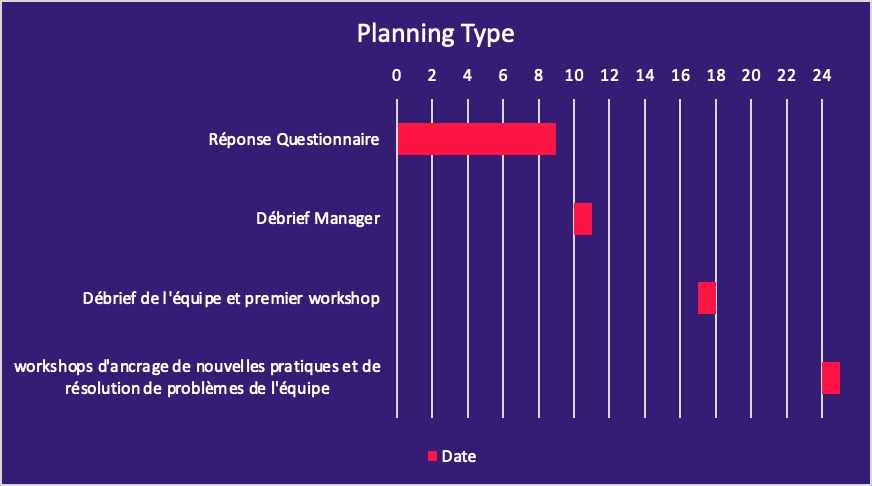
12 hours of training: 1.5 hours of managerial debriefing via video with the manager and 10.5 hours in-person with the team members and the manager, across 10 to 15 sessions over one month.
- 7 days before
Video briefing of the teams on the approach, schedule, and expectations.
- Day of training
The diagnosis
Sending of questionnaires, answered remotely on the internet.
The TeamCulture tool helps us gather your team’s expectations. The questionnaire is sent to all team members, including the manager.
- Your answers are confidential. Team results are released to the team only once the questionnaire closes, in grouped form, and only if at least five team members other than the manager have answered. NextGen’s coaches can see the results both before and after the questionnaire closes, including when fewer than five team members other than the manager have answered. The manager’s view is shown separately, and the manager knows it before answering.
- No interpersonal judgment, as it focuses on collective functioning.
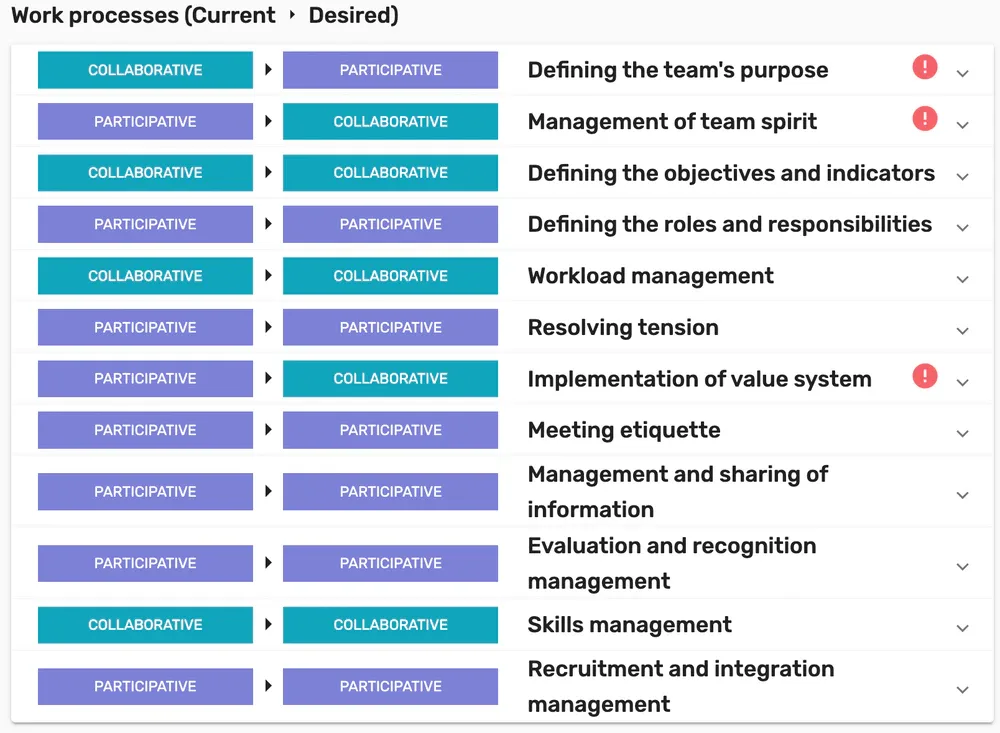
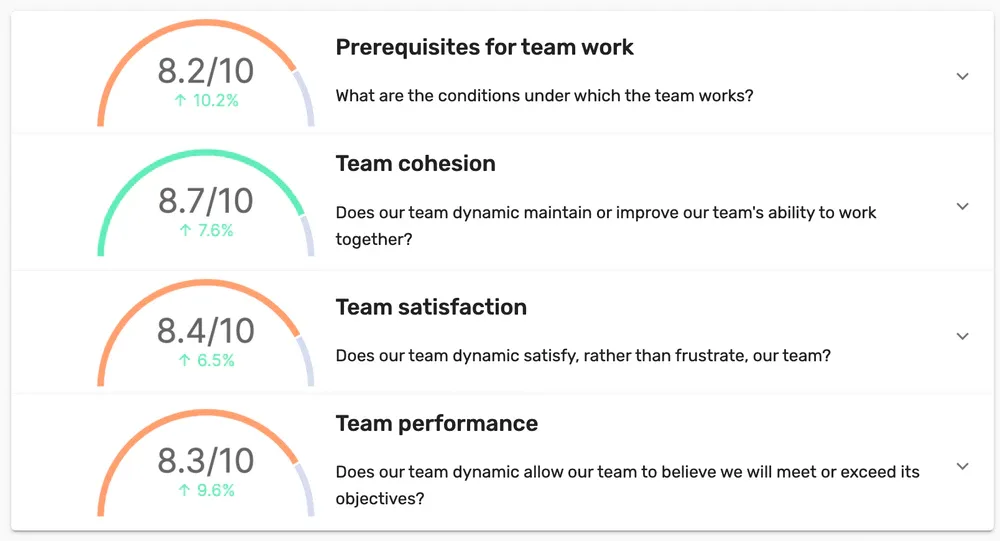
What it produces is the gap between the way the team works today and the way it wants to work:
- 10 days after
The manager’s debrief, 10 days after
Debriefing of the questionnaire results filled out by the team, conducted by the trainer (1.5 hours) with the manager.
Objective: illuminate the blind spots in managerial vision and identify areas for improvement for both the manager and the team. The trainer runs the session with the manager, for 1.5 hours:
- Inclusion round: each individual introduces themselves to the others and expresses any expectations they may have.
- Explain the purpose of the process: improving the team’s functioning, maintaining confidentiality, for the team’s benefit only — and what it is not: a ranking, an evaluation.
- Give the manager the floor with the question, “If you had to quickly outline your team’s profile and its main characteristics, what would you say?”
- Debrief the results in a positive manner: an improvement process. Listen to reactions, and if they are not spontaneous, provoke them — what do you think about certain disparities, perception levels?
- Summarize the main points to remember in 3 minutes.
- Closure: what is the manager’s feedback? What are the priorities to address at this stage according to the manager?
- 17 days after
The team seminar, 17 days after
Collective support divided into 2 parts (total of 1.5 days, i.e., 10.5 hours), conducted by the trainer with the team, including the manager:
- Workshop for analyzing the team’s results and launching the improvement action plan. The action plan will be based on best practices and existing company initiatives.
- Collective intelligence workshops based on the team’s results, aimed at aligning with the team’s working methods, experimenting with different practices, and agreeing on the next steps and appropriate action plans.
- Individual evaluation.
For each team, 1 and a half days of training and collective intelligence are planned to align with the purpose, experiment with new practices adapted to the team’s challenges, agree on the objectives of the team and design the next steps. Each team leaves the seminar having learned the constituent elements of team effectiveness, as well as with a clear vision of the action plan.
Each seminar or sequence of collective sequences is prepared in advance with the team manager, then with the team, based on the results of TeamCulture. These moments are therefore tailor-made according to the needs of each team.
Sessions serve to acquire new skills and methods, improve existing practices and resolve major problems for the effectiveness of the team; serious games can be used to help participants understand and experience forms of management where autonomy is combined with responsibility.
- 18 days after
How the result is measured
Sending of the NPS questionnaire and sharing of resources.
Evaluation takes place in the week following the training. Satisfaction is scored as a Net Promoter Score = % promoters - % detractors.
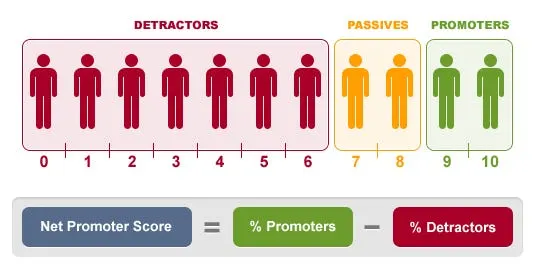
Calculation = average ratings to the tenth on a scale of 0 to 5. Satisfaction on 3 items:
- Overall evaluation,
- Facilitation,
- Organization
Accessibility: our training courses are accessible to people with disabilities. To discuss possible adjustments, contact our disability officer, Sophie Lagandré (sophie@nextgen.how), and see our Accessibility and disability page.