

Translation pending — English copy shown.
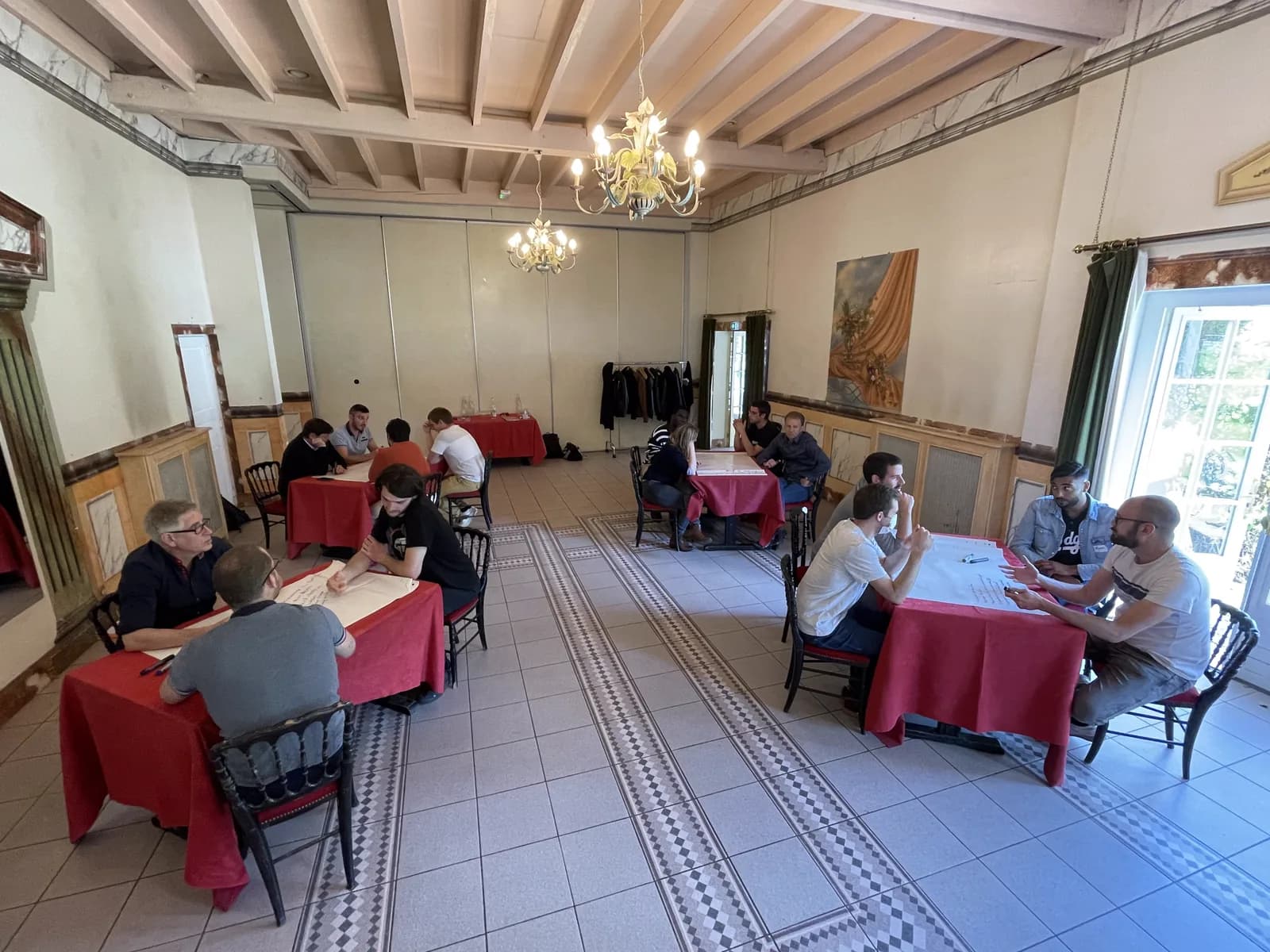
Diagnostic · with TeamCulture
Managerial maturity audit
Align how your teams work and gain in collective performance
For each team, an objective starting point: how it works today, how it wants to work, and where to act first.
- Definition and clarification of roles, responsibilities, and interdependencies: participative → participative
- Managing and resolving intra-team conflicts: persuasive → participative, misaligned
- Clarification of the team’s mission and vision: directive → participative, misaligned
- Managing decision-making and team decision-making autonomy: persuasive → collaborative, misaligned
- key work processes diagnosed
- 13
- work modes, from directive to collaborative
- 4
- criteria grouped into 5 themes
- 25
- questions online (75 for the manager)
- 88
Why it matters
Trust, autonomy, empowerment
Because they have become criteria by which talent, and the new generations in particular, choose an employer, trust, autonomy and empowerment are today major issues for organizations and for Human Resources departments, in terms of personal fulfilment, collaboration and therefore collective performance.
Not a 360° evaluation. TeamCulture reads the team’s collective dynamic, names no one, and gives everyone the same objective starting point.
Align
Match the way the team is managed with what the team actually needs.
Detect
Bring invisible friction to light: things left unsaid, roles that are not clear.
Objectify
Turn impressions into a shared, measured reading of how the team works.
Act
Improve collective performance by working on the levers that matter for this team.
What we measure
How the team works, and how well
Each team member gives, for every work process, the team’s current way of working and the one they want; then rates the team on 25 criteria. The manager answers separately.
13 work processes
The operational rails a team culture runs on.
Meaning
- Clarification of the team’s mission and vision
- Alignment of values, norms, and expected behaviors
Execution
- Definition and clarification of roles, responsibilities, and interdependencies
- Setting SMART objectives and key performance indicators (KPIs)
- Managing cohesion and group dynamics
- Planning and coordination of operational activities
- Optimizing communication processes in meetings and managing interactions
- Managing information flow and ensuring organizational transparency
- Managing and resolving intra-team conflicts
- Managing decision-making and team decision-making autonomy
People
- Developing collective skills and capacities
- Implementing an evaluation and recognition system based on behavioral and performance indicators
- Managing recruitment, onboarding, and retention of talent
4 work modes
For each process, where the team is and where it wants to be.
- Directive
- The manager decides alone and gives precise instructions.
- Persuasive
- The manager decides, then explains and convinces.
- Participative
- The manager consults the team before deciding.
- Collaborative
- Decisions are built together, with shared responsibility.
Inspired by Hersey and Blanchard’s situational leadership: no mode is better in itself, the right one depends on the process and the team.
25 criteria in 5 themes
Each theme builds on the one before. The model can be adapted to your own management framework.
1 · The foundation
Shared vision and objectives
- Clarity of shared objectives
- Clarity of shared roles
- Ability to rely on one another to succeed
- Commitment to common objectives
- Mastery of the external context
2 · The cement
Cohesion and interpersonal trust
- Trust
- Kindness
- Right to make mistakes
- Humility
- Availability for collective support
- Sense of belonging to the team
3 · The nervous system
Communication and feedback
- Feedback culture
- Continuous improvement
- Managerial recognition
- Respect within the team
- Respect from other teams
4 · The fuel
Autonomy and professional development
- Autonomy in action and initiative
- Workload assessment
- Career development opportunities
- Access to continuous learning
- Well-being at work
5 · The result
Performance and adaptability
- Ease of achieving objectives
- Managing uncertainty
- Creativity in problem-solving
- Engagement
What each team receives
A clear reading, ready to discuss
Pages from a real TeamCulture report, shown with fictitious data.
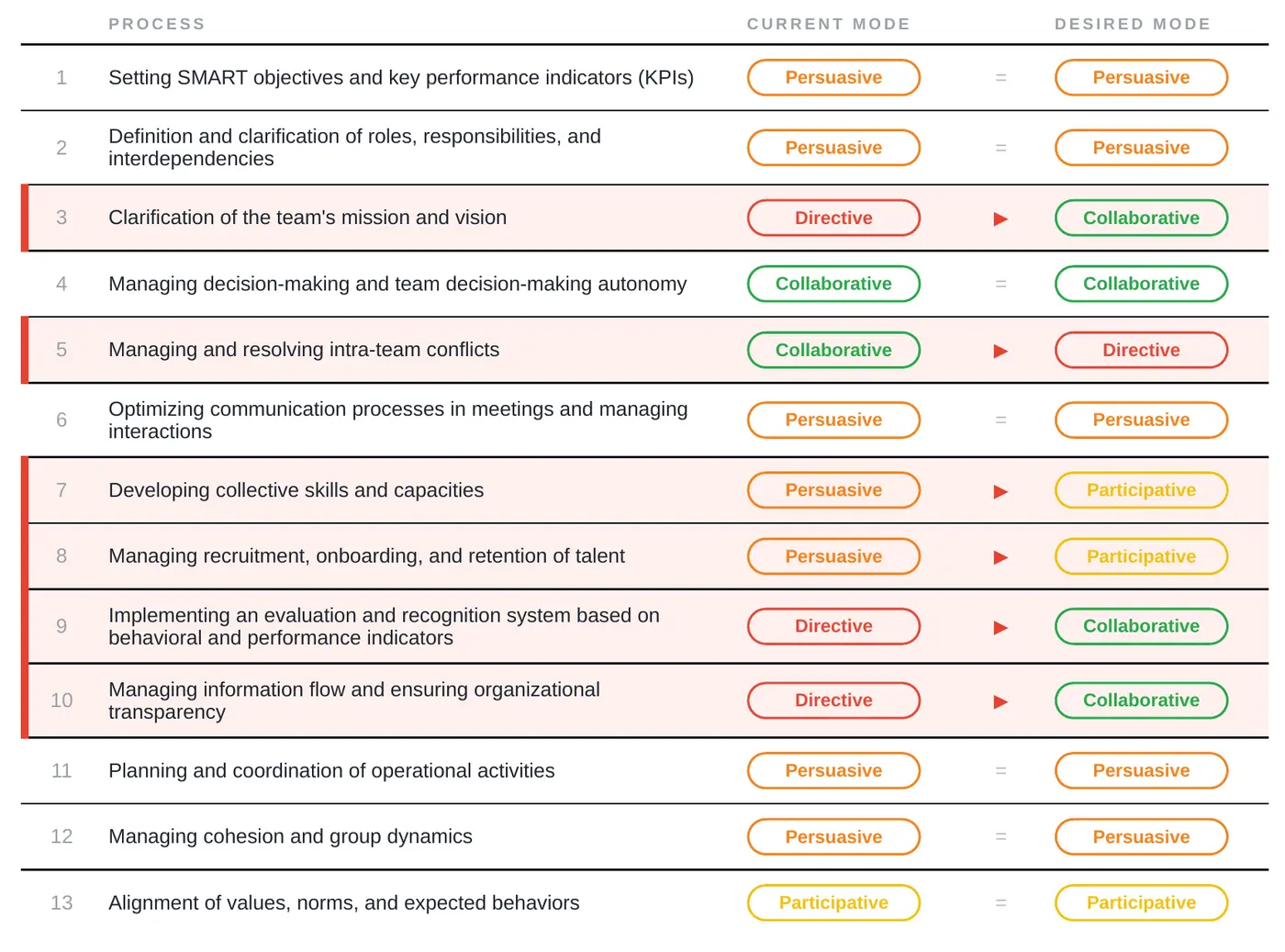
The work-mode map
Current and desired mode for each of the 13 processes, with the misaligned ones flagged, and the number of processes where they match.
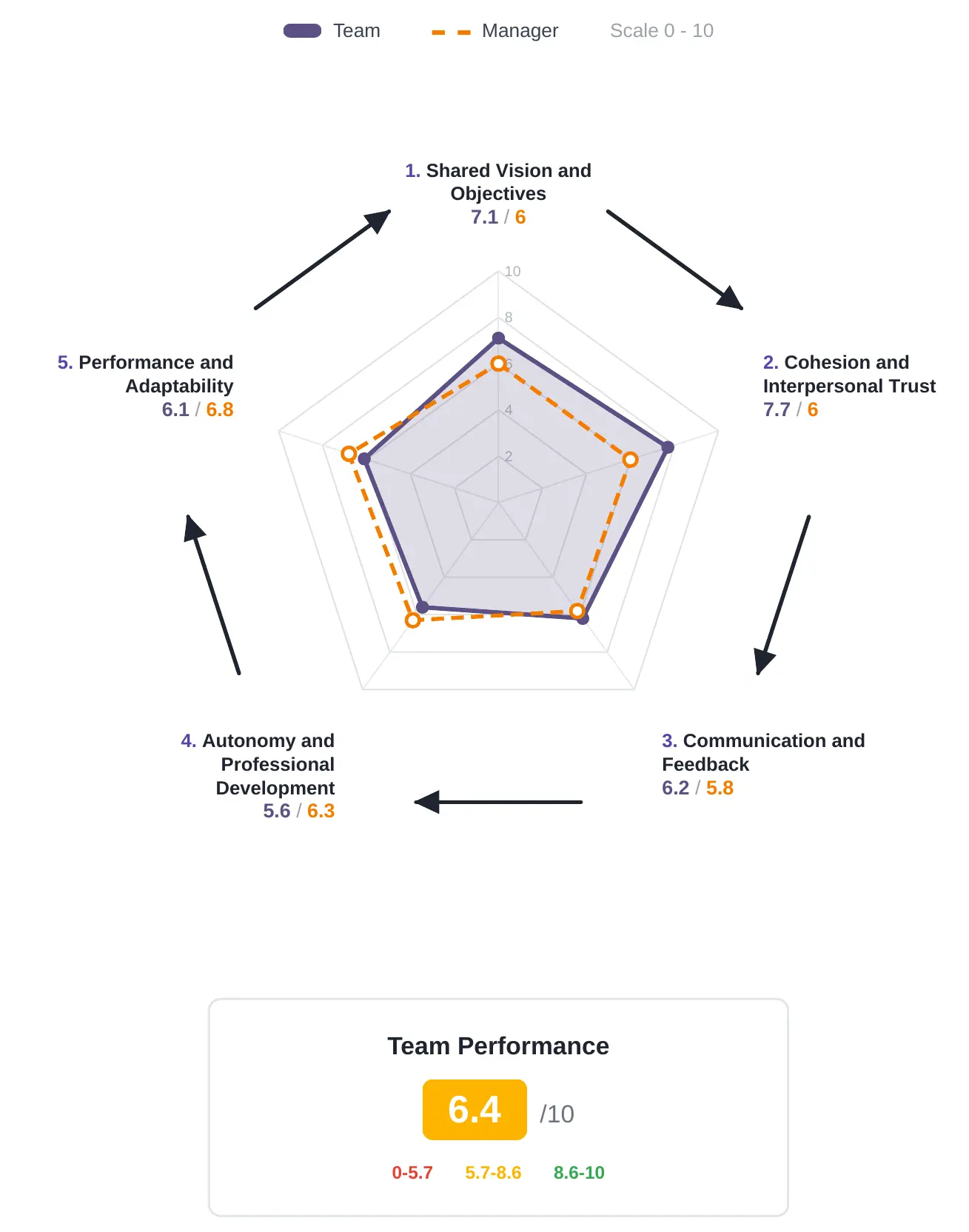
Team performance
The 25 criteria scored out of 10 and grouped into the five themes, the manager’s perception beside the team’s.
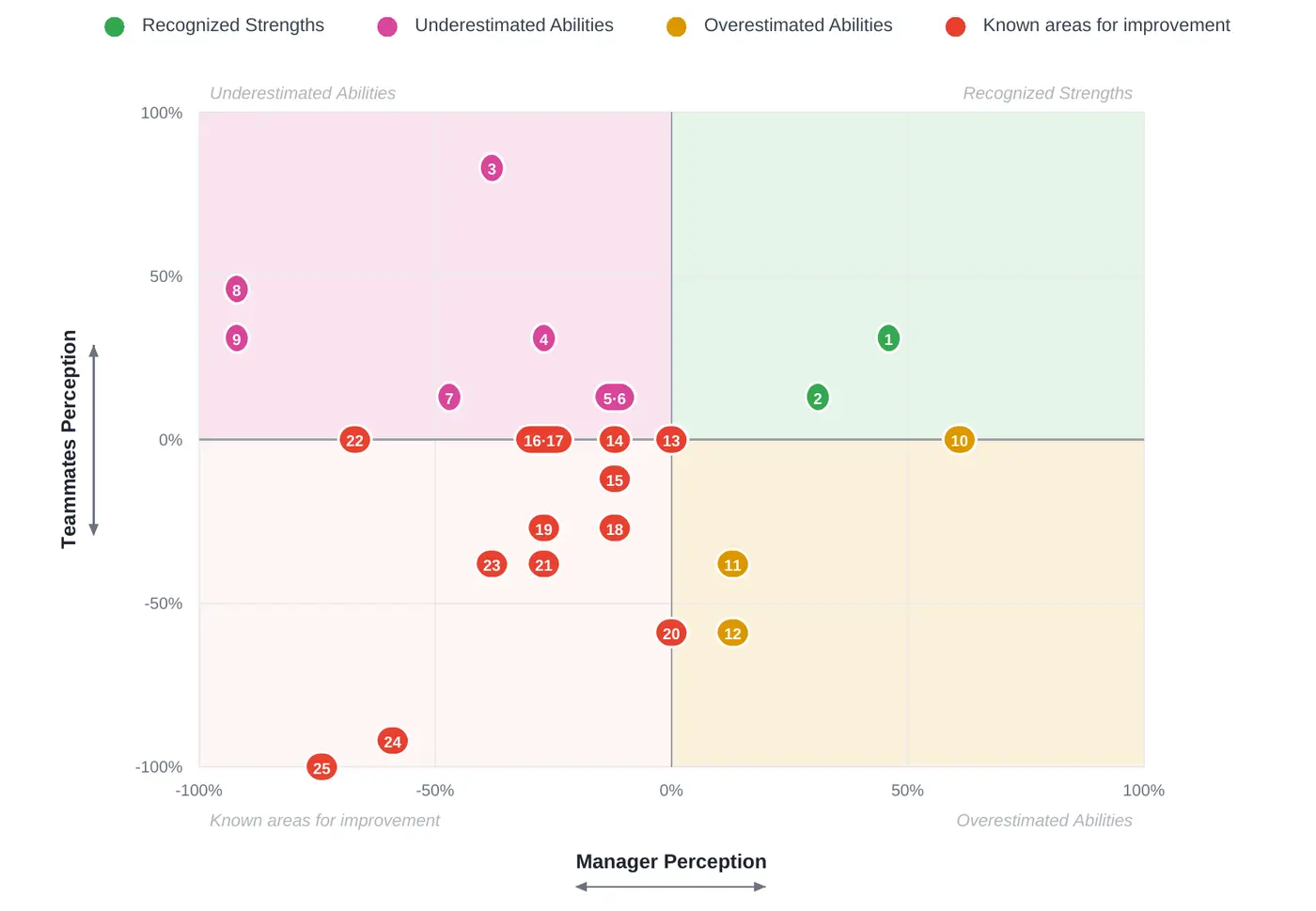
The perception map
Where the manager and the team see things the same way, and where they don’t: the gaps are where the untapped levers are.
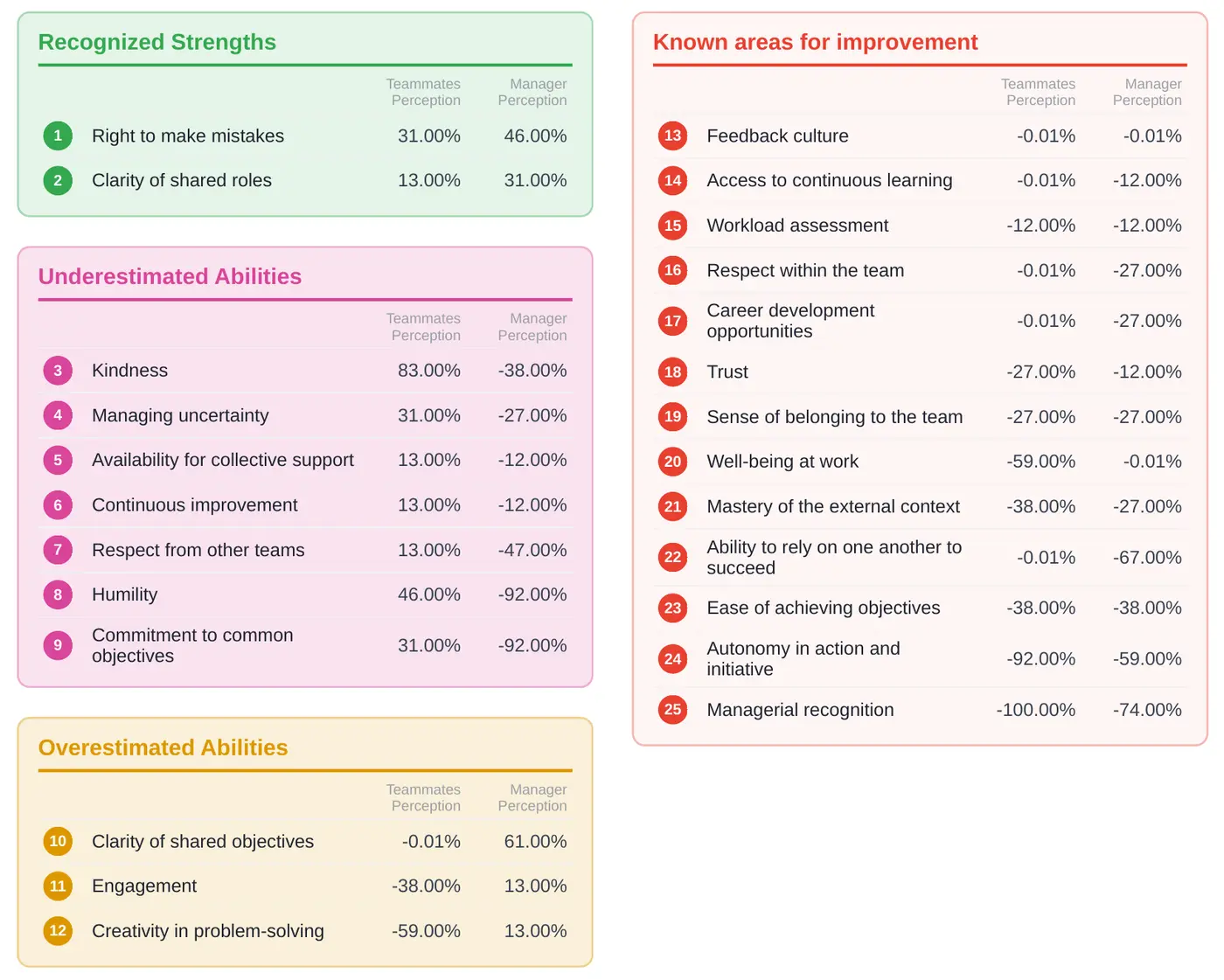
Strengths and priorities
Each criterion sorted into recognized strengths, underestimated or overestimated abilities, and known areas for improvement, from most to least favourable.
A four-step approach
- Inspiration
- Diagnostic
- Seminar
- Coaching in parallel
- Step 1 · Inspiration1 h 30 or a half-day
An inspiration session for each team
A workshop of an hour and a half or a half-day led by Luc Bretones, to share the testimonies from his book, explain the approach and answer questions.
The idea of this step is to make people want to take part, to detail the steps and to lift fears.
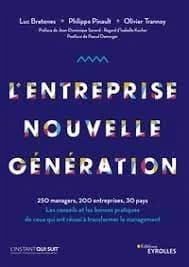
The bookThe Next Generation EnterpriseLuc Bretones, Philippe Pinault, Olivier Trannoy - Step 2 · Diagnostic88 questions
A diagnostic of each team with TeamCulture
Each team member fills in an 88-question questionnaire online, remotely (the manager: 75).
Analysing the gap between the team’s current way of working and the one it wants, together with measuring the current effectiveness of its dynamic, makes it possible to define and prioritise workshop formats to accelerate the transformation.
Analysis of the gap between the team’s current way of working and the one it wants
From an online questionnaire filled in by each team member, a summary table shows, for each of the 13 processes, the team’s current work mode and the mode it wants, and flags the processes where they differ.
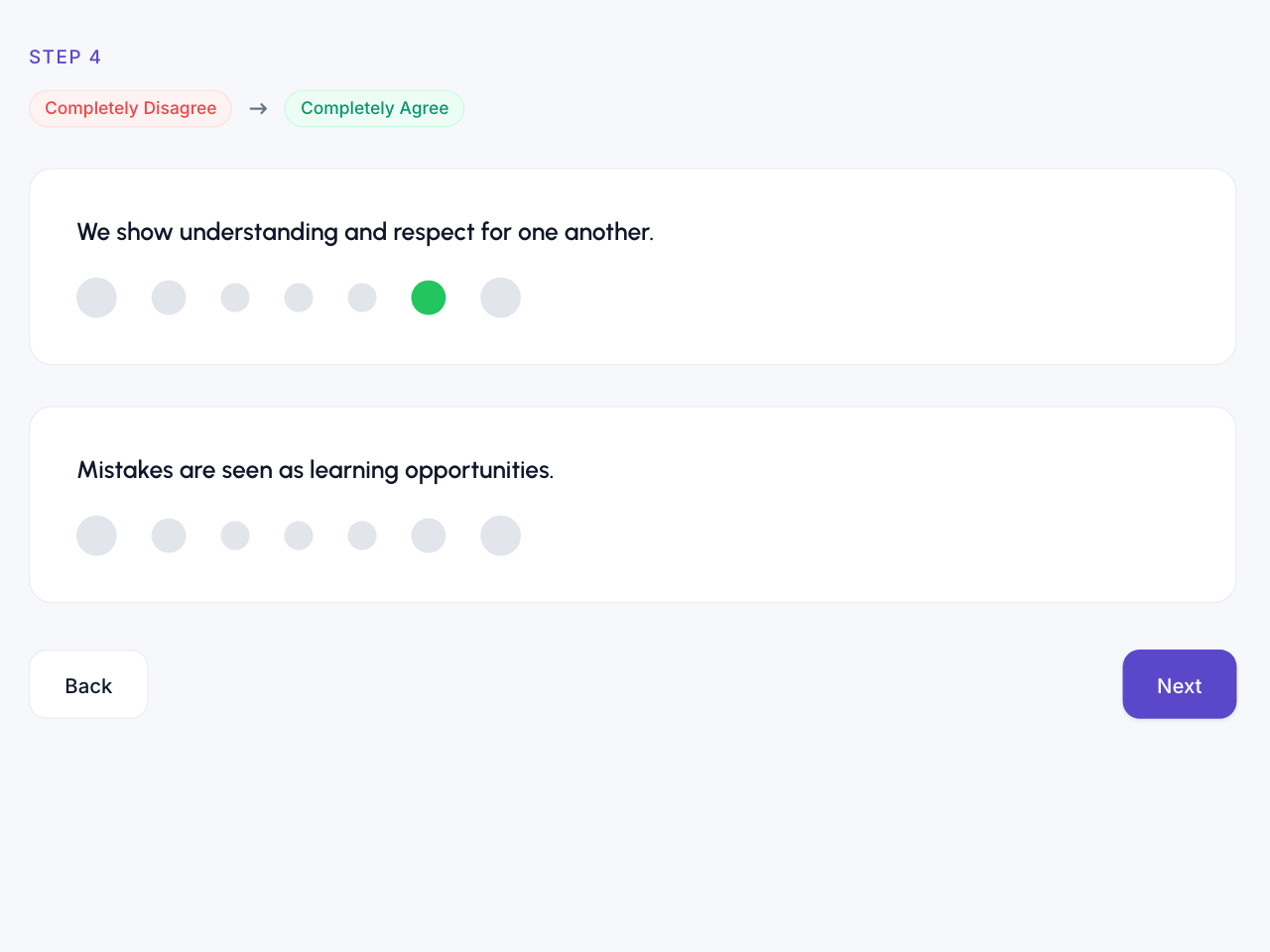
The questionnaire 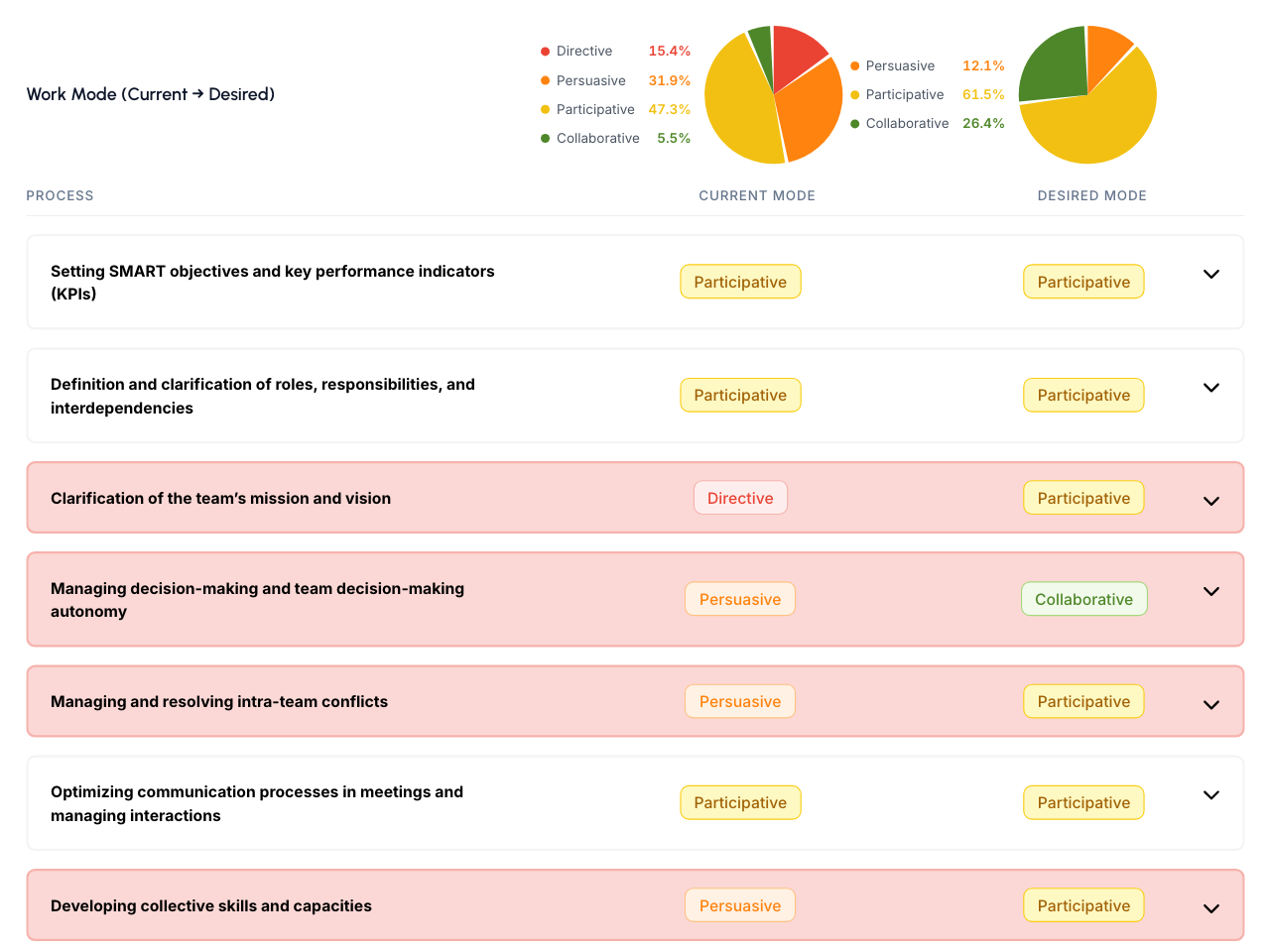
Current → desired work mode, process by process; in pink, the processes where they do not match (fictitious data) 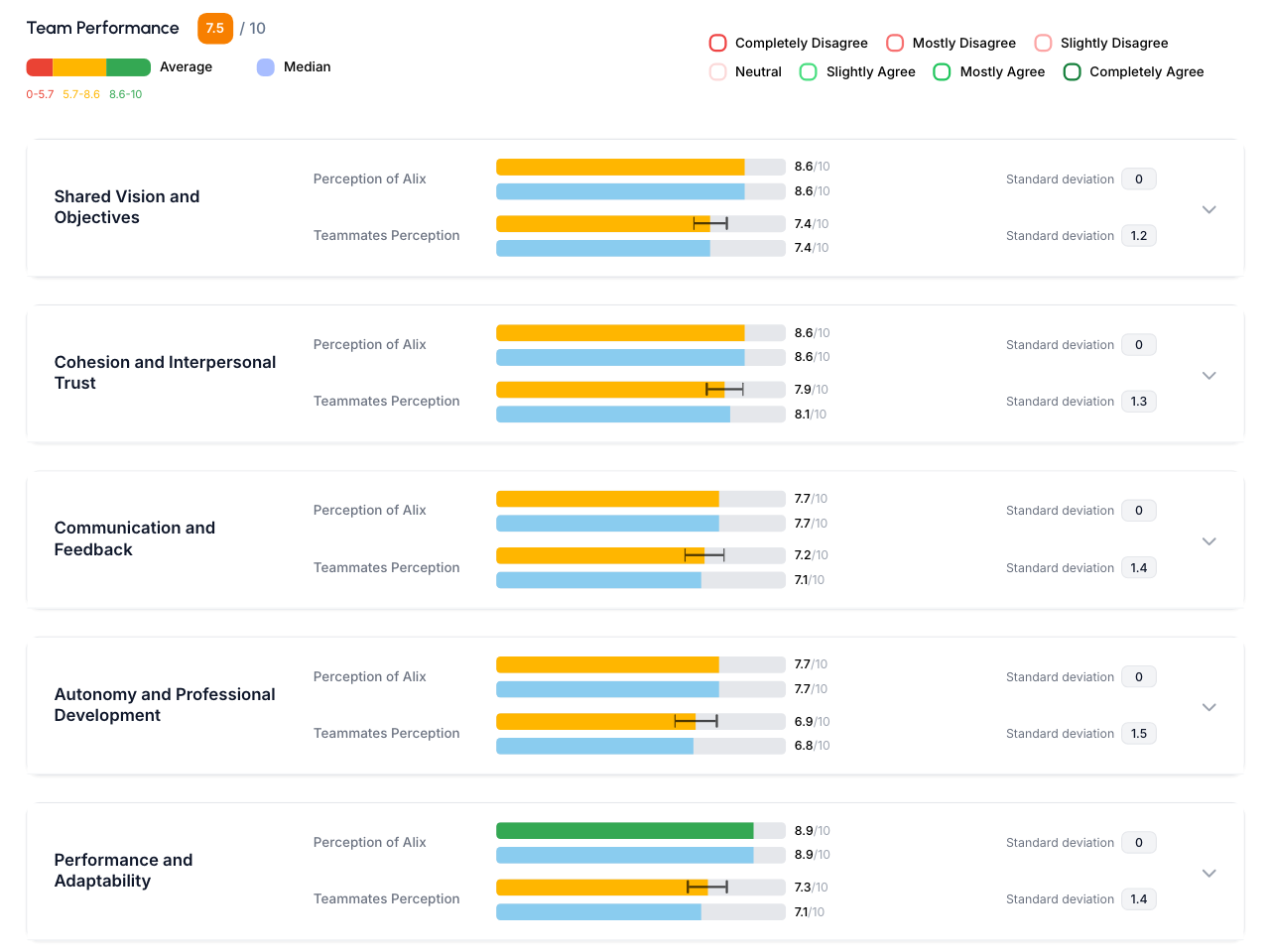
The “Team Performance” screen: 25 criteria grouped into 5 themes, shown out of 10, the manager’s perception and the teammates’ perception (fictitious data) - Step 3 · Seminar1 to 2 days per team
A seminar to present the results, co-build and launch the transformation project
The manager discovers the results first, in a one-to-one debrief. The team then discovers them together and votes on its priorities.
For each team, 1 to 2 days of collective intelligence to debrief the diagnostic, align on the purpose, experiment with and anchor new practices where needed, and agree on the next steps.
Each team leaves the seminar with a clear view of the action plan.
- Step 4 · CoachingIn parallel
From words to deeds: change starts with yourself
In parallel, we recommend starting individual coaching for the managers or employees who wish to be supported in the evolution of their posture.
Regular individual or small-group coaching to help Managers move towards a “Servant Leader” posture and to work with some employees on situations of deadlock or misunderstanding.

About TeamCulture
Your questions
TeamCulture is NextGen’s web application for diagnosing teams.
Discover TeamCultureIs this a 360° evaluation?
No. A 360° assesses a named person. TeamCulture reads the collective dynamic of a team: it names no one, and gives the team a shared, objective starting point.
Who sees the results, and when?
Results are released to the team only after the questionnaire closes, and only if at least five team members other than the manager have answered. NextGen’s coaches can see the results both before and after the questionnaire closes, including when fewer than five team members other than the manager have answered.
What does each person answer?
For each of the 13 work processes, the team’s current way of working and the one they want, from four modes (directive, persuasive, participative, collaborative); then a rating of 25 criteria grouped into 5 themes, which the manager also rates separately. 88 questions online, 75 for the manager.
What indicators does it produce?
Two: the number of processes where the current and desired modes match (out of 13), and the current effectiveness of the team’s dynamic (out of 10). Together they place the team on a dynamics matrix.
Can it fit our own management model?
Yes. The criteria model can be adapted to your managerial framework.
Give each team an objective starting point
Tell us about your teams. We design the audit with you, from the first session to the follow-up.