

Translation pending — English copy shown.
Agentic software factory
Agents execute. Engineers decide.
Most teams today hand agents a single step: writing code.
We hand them all the others, except the merge decision. Your engineers set the direction and decide what goes to production.

The software factory at a glance
- Steps in the chain
- 8
- Risk-based review levels
- 3
- Decisions kept by a human
- 2
A complete chain, steered and controlled.
Agents take on every step of the development cycle, except the merge decision. A single platform steers them, follows sessions live and measures the flow.
Why now
Producing has never been so cheap
Drafting a memo, analysing a file, writing code: AI agents can now take most of these tasks on. A well-equipped person covers end to end what used to involve several people.
Value therefore shifts towards judgement: understanding the problem closely, choosing what is worth doing, keeping the whole coherent, making trade-offs.
Risk-based review
Human control follows risk
Every change is classified by what it touches. The more sensitive it is, the more senior the person who approves it, and for critical areas, no agent merges.
Experimentation
Internal tools, prototypes, tests, documentation: anything easy to fix.
Standard
User-facing features that can be switched on and are reversible.
Critical
Payment, authentication, security, infrastructure, core business.
The chain
Eight steps, one loop
Most teams only hand agents the writing of code. We break the whole cycle into steps and hand each of them to agents, except two decisions that stay human.
Supervision in turn feeds new signals: the loop is closed.
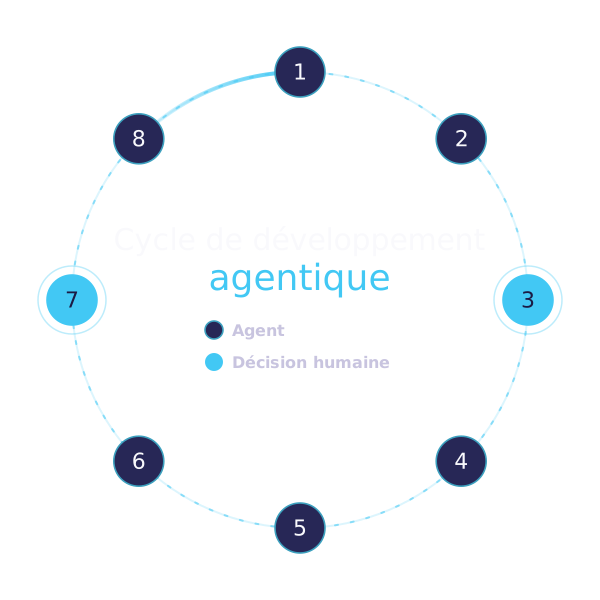
- Signals Messages, tickets, alerts and usage data feed the chain.
- Specification A plan is drafted, then shared between agents and humans.
- Specification sign-off A person approves the intent and the approach. Human decision.
- Code generation Several agents work in parallel, in isolated environments.
- Automated review House rules are applied, backed by evidence and a risk level.
- Tests and QA Unit tests and journeys tested like a user.
- Merge and deployment A person decides on the merge; deployment is progressive, with automatic rollback. Human decision.
- Supervision Errors, performance and field feedback are tracked, and feed new signals.
Not “vibe coding”
Speed, with more engineering
This is not a prompt and a demo, but changes that go through the same requirements as in any team: security, tests, continuous integration, release process.
- Your environments, your accounts
- Nothing merged without a human
- One automated review per change
- Flow measured step by step
Maturity
Six levels, from assistant to software factory
Each team starts from its real level. The challenge is not the tool, but the move from one agent to several, steered and controlled. We agree with you a realistic target and the path to reach it.
- N0
No AI
Code is written without AI assistance.
- N1
Autocomplete
The tool completes the current line; the developer writes the rest.
- N2
Copilot
AI suggests, the human writes.
- N3
One agent
One agent completes a whole task.
- N4
Parallel agents
Several agents, in isolated environments.
- N5
Software factory
A complete orchestrated chain, reviewed according to risk.
Our support
Four steps, until your teams are autonomous
We start from your real level, without imposing a ready-made model. The goal: shorten the time between an idea and its release to production, without giving up anything on security or reliability.
Diagnostic
Where your teams stand, where time is lost, what the bottlenecks, risks and strongest opportunities are.
Acculturation and training
For executives, managers, business teams and tech teams, with NextGen Academy, a Qualiopi-certified training organisation.
Pilot lab
One painful problem, tackled fast and assessed over a few weeks of real use, then a decision: keep or stop.
Industrialisation and handover
A tooled chain, guardrails, indicators, then a handover to your teams so that they become autonomous.
Where do your tech teams stand?
Do you want to assess what an agentic software factory would change for your teams? Contact us for a first conversation: we start from your challenges and propose a tailored roadmap.